








photo home-76.png photo about-71.png photo contact-65.png photo press-19.png photo LDV.png photo services-7.png
Showing posts sorted by relevance for query design under the influence. Sort by date Show all posts

Wednesday, March 21, 2012

Design Under the Influence: Saarinen’s Tulip Collection

Hello, it's Erika from small shop — welcome to another edition of "Design Under the Influence!"

One of my favorite pieces of furniture in our home is our Saarinen tulip side table (above). It's a modern form that for me represents so much more than just a handy place to set your drink: it's a piece of design history. You probably recognize it's Star Trek-like pedestal shape, but you might not know exactly how that shape came to be.

The creator of the Tulip Chair and Table — architect Eero Saarinen -- studied sculpture at Académie de la Grande Chaumière in Paris, prior to emigrating to the U.S. to study architecture. This background provided him with a unique sensitivity to form in his buildings and furniture designs, in which he strove for "consistency and relatedness of all parts." Makes sense that the architect behind the St. Louis Arch and JFK's TWA Terminal was also a sculptor, doesn't it?

St. Louis Gateway Arch by Eero Saarinen

JFK TWA Terminal by Eero Saarinen

In 1956, Saarinen set out to design a furniture collection that would "clear the slum of legs in the U.S. home." With this objective, he was able to functionally achieve a simple one-legged structure while applying his own expressive sculptural sensibilities to the form. The now-timeless Pedestal Collection for Knoll included a chair, armchair, dining table, coffee table, side table and stool.

The Tulip Chair and Table have become design classics that have endured through the decades, and it excites me to see them used in a multitude of settings and styles to this day. A sampling:

Celerie Kemble & Anna Burke via Lonny

via Flickr

Miguel da Cunha via Nuevo Estilo

Laura Garcia via Lonny

Beth Haley

Trip Haenisch via Lonny

via Design Within Reach

via Marie Claire Maison

Concha Rodríguez via Nuevo Estilo

Barrie Benson via Domino

Barrie Benson

via Design Within Reach

via Design Within Reach

Michelle Adams via Lonny

El Palauet Barcelona Modernista suites

Oh what I would give to own a Saarinen dining table! But for now, our little side table will do just fine.

For more Saarinen inspiration, visit my "Design Under the Influence" Pinterest board!

Wednesday, June 13, 2012

Design Under the Influence: The Gallery Wall

small shop

Hello, it's Erika from small shop, and today for our "Design Under the Influence" I'd like to talk about the well-loved gallery wall. Seems that the popularity of this style of arrangement is still on the rise! I did a post last year before I decided to create my own gallery wall (above), and I kept finding more and more beautiful examples to share!

I bet you have a vague recollection from some image you may have seen somewhere that the gallery wall originated in pre-Revolutionary France. We have record of "salon" style art viewing from the exhibitions of recent graduate work at the Royal Academy of Painting and Sculpture in Paris in the 1670's. In 1737, the Academy began to hold the Salon for public viewing at the Louvre, and until the late 1800's, the Salon was the first critical test for an artist's success — if you didn't make it here, you didn't make it.

1785 Salon by Pietro Antonio Martini

That is, until Impressionists, Post-Impressionists, and Fauvists hit the scene, and were NOT well-received at the traditional salons. This is where private salons like Gertrude Stein's (see my previous "Design Under the Influence" post here) come in. Still hung floor to ceiling, the gallery wall in their home became a resource for off-the-radar artists like Picasso and Matisse to see works from contemporaries. But unlike the traditional Salon, this was in a private residence, and owned by a private collector.

Gertrude Stein's Salon in Paris

Today, our gallery walls are much more akin to the Stein Salon: our little private collections of pieces we love and want to share and appreciate. When creating your own gallery wall, I have these 5 tips:

Last tip, get your good fill of inspiration from these excellent examples!

Julia Leah, Lonny

Blaire Clark, Lonny

Dwell Studio

Ashley Putnam, Lonny

Kate Spade, Matchbook

Modern Declaration

Beth Rudin, Elle Decor

Elettra Wiedemann, Vogue APT

Federico de Vera, Elle Decor

Angie Hranowsky

Angie Hranowsky

Lela Rose, New York Times

Do you have a gallery wall in your home? What are your tips and tricks for creating a successful display?

Wednesday, December 28, 2011

Design Under the Influence: Vincent Van Gogh

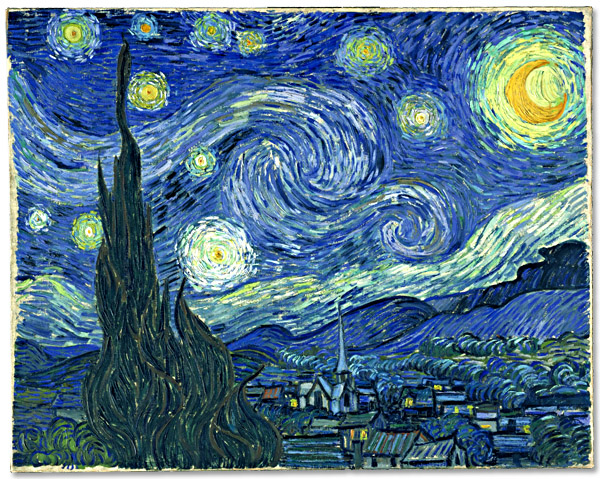
[ Vincent Van Gogh, The Starry Night, 1889 ]
"I make a plain background of the richest, intensest blue that I can contrive, and by this simple combination of the bright head against the rich blue background, I get a mysterious effect, like a star in the depths of an azure sky."
Erika from small shop here, bringing you a sixth edition of "Design Under the Influence"! I wanted to take a post to talk about one of the most recognizable paintings in modern history, post-impressionist Vincent Van Gogh's The Starry Night (1889), for a few reasons: his place in art history, his technique, his signature hue, and his influence on modern music.
HIS PLACE IN ART HISTORY:
While Impressionists like Claude Monet advanced modern painting with refusing to paint exactly what they saw, they still used the colors that they saw, i.e. true colors of the natural world. Van Gogh strove to use imaginative color and exaggerated movement in order to express emotion rather than reality -- a very modern thought at the time! And if you think about the fact that The Starry Night was painted purely from memory, you can't help but be affected by the brilliance of this clearly creative mind.
HIS TECHNIQUE:
If you've ever been lucky enough to see a Van Gogh painting in person, then you know that it jumps out at you: the depth and dimensionality make you feel as if you could walk right into it! This is because of two reasons: first, Van Gogh was a master at using complementary colors against each other to intensify the luminosity of each. And secondly, he carefully built up his brushstrokes in layer upon layer to create a 3-dimensional depth that is very intentional: although the movement of the brushstrokes often look hurried and sporadic, it is said that he would sometimes paint only one stroke a day!
HIS SIGNATURE HUE:
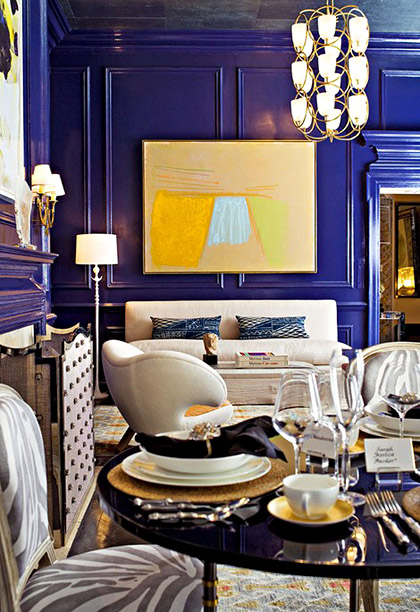
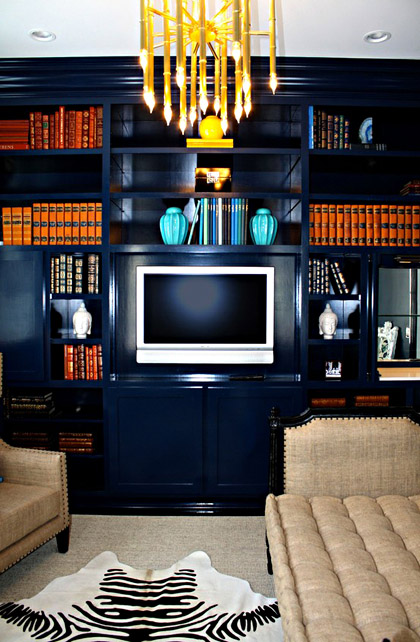
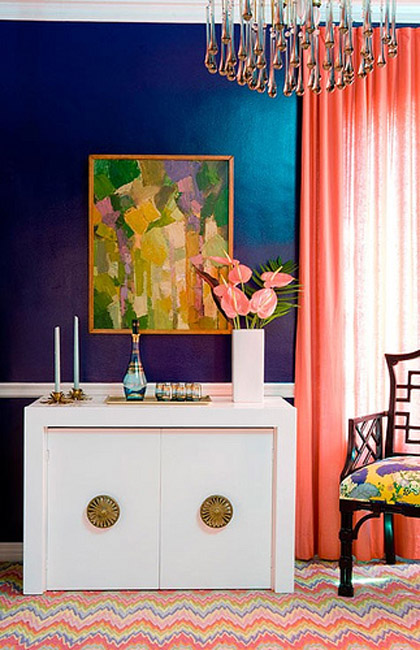
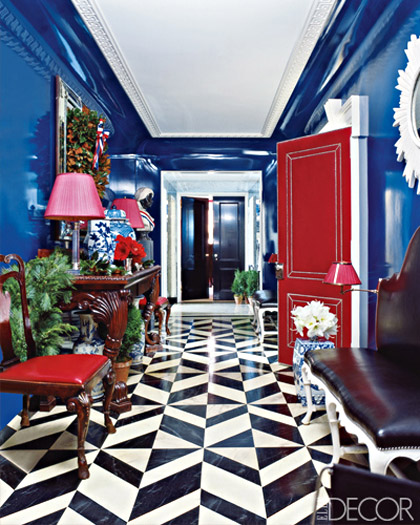
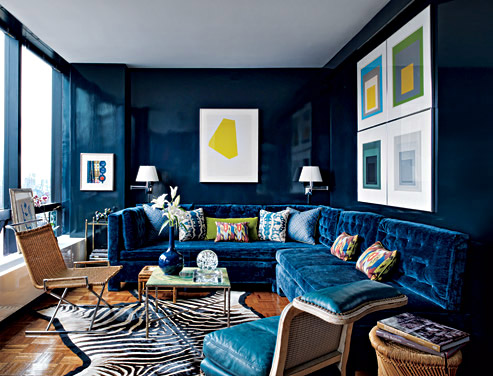
One aspect of his paintings that I particularly love is his use of a vibrant indigo blue that is so intense you can't take your eyes off it. It reminds me a bit of rich blue lacquer walls we've been seeing a lot in interiors lately. Especially when paired with its complementary yellow/orange, I can't help but think they must have been influenced by Van Gogh's paintings. Nonetheless, it's a finish with a big impact:
[ Flickr ]
HIS INFLUENCE ON MODERN MUSIC:
And how about art influencing music? I for one think it's kind of neat that The Starry Night inspired one of the most beautifully written songs in the 1970's: Don McLean's Vincent (1970). McLean recalls he was reading a book about the artist and the painting, and felt compelled to pick up his guitar.
"Looking at the picture, I realized that the essence of the artist’s life is his art. And so, I let the painting write the song for me.”
Isn't that beautiful? And have you heard Roberta Flack's equally beautiful song Killing Me Softly With His Song (1973)? The backstory is that the original singer was so moved by a Don McLean performance that she wrote a poem and passed it on to a writing team that penned the song.
Some fun facts for you...hope you enjoyed it and will pass it on!

Wednesday, October 17, 2012

Design Under the Influence: Breuer Caned Chair

Hello, it's Erika from small shop, and for this "Design Under the Influence" I thought I'd focus on a chair that I grew up with: the Breuer caned chair. "It's among the 10 most important chairs of the 20th century," said Cara McCarty, associate curator, department of architecture and design at the Museum of Modern Art (New York Times, 1991).


You may think this chair is straight out of the 1970's, but the original design actually dates back to 1928. Marcel Breuer, the designer, was a Bauhaus-trained architect that revolutionized the traditional chair in 1925 by using tubular steel in his famous Wassily chair -- inspired by the handlebars on his bicycle! With his B-32 "Cesca" design in 1928 (named after his daughter Francesca), he successfully married traditional and modern materials and techniques with his use of industrial steel and natural caning, creating the "perfect modern" chair. Additionally, the engineering of his cantilever was particularly ingenious, as the tubular steel frame was significantly lighter than previous attempts by other designers. By adding a sturdy wood frame to the seat and back, he eliminated the need for the additional support, leaving a light, elegant structure.
I particularly like how this modern masterpiece adds just enough of a retro feeling to a room without overpowering it:

As significant of a design that it was, it's surprising how rare it is these days that we see them in interiors magazines. But whenever I do, I get hit with a sense of nostalgia and a desire to snatch up a set for myself!
"Mass production made me interested in polished metal, in shiny and impeccable lines in space, as new components of our interiors. I considered such polished and curved lines not only symbolic of our modern technology but actually to be technology." ~ Marcel Breuer